
More Than a Survivor
- Seven's Grace

- Jul 6
- 3 min read
Understanding the Weight of the Word.
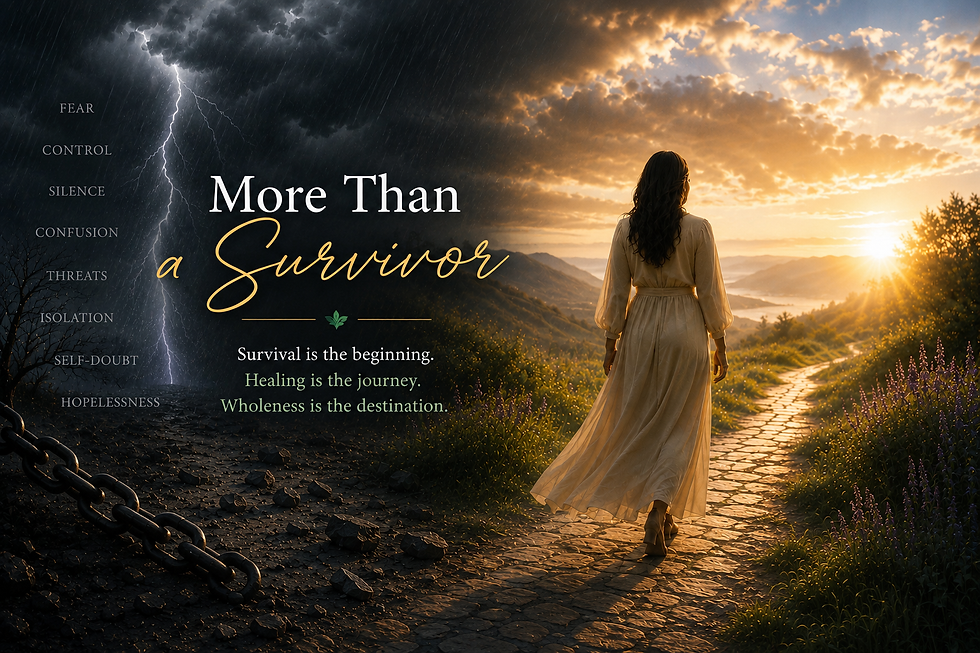
The word survivor is often used so frequently that it can begin to lose its meaning.
We hear it in conversations, support groups, and awareness campaigns. We celebrate survivors. We encourage survivors. We stand with survivors.
But what does it actually mean to survive?
To survive means to continue living after an event that had the potential to end your life. We use the word for people who survive cancer, natural disasters, serious accidents, combat, and life-threatening illnesses.
Domestic abuse belongs on that list.
Too often, society minimizes domestic abuse by viewing it as a relationship problem rather than a public health and safety issue. Yet the data tells a very different story. Millions of people experience intimate partner violence every year in the United States, and women are disproportionately affected by severe violence. More than half of female homicide victims are killed by a current or former intimate partner. Intimate partner violence is not simply about conflict within a relationship—it can be a matter of life and death. (CDC)
For many women, surviving abuse means surviving far more than physical violence.
They survive coercive control, intimidation, threats, isolation, financial abuse, and psychological manipulation. They survive fear that follows them long after the relationship has ended. Some survive assaults that require emergency medical care. Others survive repeated strangulation, one of the strongest known indicators that future violence may become lethal. Research has consistently shown that non-fatal strangulation is associated with a significantly increased risk of homicide.
When we call someone a survivor, we are acknowledging something profound.
We are recognizing that they lived through circumstances that could have destroyed not only their confidence, identity, or peace—but in some cases, their very lives.
At Seven’s Grace, however, we also recognize that surviving is not the end of the journey.
Survival is just the beginning. A survivor has escaped the immediate danger. Then comes healing, recovery, rediscovering identity, learning to trust again. Building a life marked by balance, purpose, connection, and wholeness comes afterward.
That is why our journey begins with awareness but does not end with survival.
Our hope is that every woman who comes to Seven’s Grace moves beyond merely surviving. We want her to heal. To grow. To reconnect with herself and with others. To discover that life can become more than the absence of danger—it can become the presence of peace.
The word survivor deserves to be honored.
Not because it is the final destination. But because it represents extraordinary courage. It tells the story of someone who lived through what could have taken everything. And from that place, a new story can begin.
Reflection Questions
When you hear the word survivor, what comes to mind? Have you ever minimized an experience because you compared it to someone else’s? What would it mean to honor your own journey—not only for what you endured, but for the courage it took to keep going? How might your healing change if you viewed survival as the beginning of restoration rather than the end of the story?
A Simple Practice
Take a few quiet moments to reflect on a season in your life that required extraordinary courage. Instead of focusing only on what you lost, write about what helped you endure.The Restoration Journal
Consider the strengths, values, relationships, or faith that carried you through.
Then write one sentence that begins:
“Because I survived, I now have the opportunity to…”
Healing begins when we recognize that survival is not simply about living through something.
It is about discovering that life is still possible on the other side.


Comments